 Pharaohexchange
 slippage tolerance sets an output floor for fixed-input swaps
Pharaohexchange slippage tolerance sets the minimum output amount a fixed-input router call checks. Minimum received translates the tolerance into an execution floor. Price impact affects the quote, while later market movement can change execution. Output below the submitted floor causes rejection.
Bottom line: For the same fixed-input quote, a looser tolerance lowers minimum received without improving the pool price behind the quote.
Router methods determine which amount you control
Exact-input calls specify an input amount and reject output below a minimum; target-output methods cap spending against an output target. At contract level, the legacy and V3 routers expose both approaches. A particular application screen determines which methods its interface makes available. The relevant limit belongs to the method the transaction actually calls.
| Router method | Amount the caller limits |
|---|---|
Legacy
swapExactTokensForTokens
|
Minimum calculated final output through
amountOutMin
.
|
Legacy
swapTokensForExactTokens
|
Maximum input through
amountInMax
.
|
V3
exactInputSingle
|
Minimum single-pool output through
amountOutMinimum
.
|
V3
exactInput
|
Minimum final path output through
amountOutMinimum
.
|
V3
exactOutputSingle
|
Maximum input through
amountInMaximum
; a nonzero pool price limit can allow partial target output.
|
V3
exactOutput
|
Maximum input through
amountInMaximum
for the requested path output.
|
The output floor applies to exact-input calls. Target-output calls instead require attention to maximum input. In V3's single-pool target-output method, the optional pool price limit also matters. With a nonzero limit, a spending cap alone does not establish delivery of the full target amount. In exactInputSingle, reaching the pool price limit can leave some input unspent, provided the output minimum is met.
How does minimum received limit execution?
A fixed-input swap rejects execution when the output amount its router checks falls below the transaction's minimum received amount. Output equal to that floor passes this particular check, although other transaction requirements still apply. The quote describes expected output; the floor defines the acceptable lower boundary. For transfer-tax output tokens, the standard legacy fixed-input token-to-token method checks calculated output, while its fee-on-transfer variant checks the recipient's balance increase.
Quote and floor in matching units
Let
Q
represent quoted output and
M
represent minimum received, both measured in the same output token. The difference measures how much less output the transaction permits relative to that quote. Use the actual displayed amounts when interpreting this gap.
Allowed token shortfall
The permitted shortfall is
Q - M
output tokens. This amount concerns the selected swap, rather than the wallet's entire balance. It also excludes AVAX spent on gas. Comparing quantities from different tokens would give the subtraction no useful meaning.
Output-relative percentage
For a positive quote with a floor no higher than that quote, the permitted percentage shortfall is
100 * (Q - M) / Q
. If
r
denotes this output-relative percentage, the same relationship gives
M = Q * (1 - r / 100)
. These equations describe the quote-to-floor gap; the submitted minimum governs execution, including token precision and rounding.
Price movement and price impact have different causes
Price impact comes from the trade consuming available pool liquidity, so it can affect the quoted rate before submission. Larger inputs relative to available depth generally produce greater impact. Widening tolerance leaves that initial pricing problem intact: it permits additional deterioration against the quote without adding liquidity or improving the pool's exchange rate. Slippage measures the difference between quoted and executed pricing. Other trades can change pool balances before inclusion, while providers can change available liquidity. Volatility and delayed confirmation increase the opportunity for those changes. A quote with modest price impact can therefore still face execution movement.
MEV can also affect execution around a pending trade. A minimum-output check constrains the accepted output; it does not establish why pool conditions changed. An adverse quote-to-fill difference alone cannot distinguish ordinary market movement from a particular trading strategy.
Liquidity along the quoted route
A quoted route may cross one pool or several pools. Routing considers available liquidity, fee tiers, price impact and expected output. A path involving more pools can provide useful liquidity access, while a direct path can avoid intermediate conversions. Pool count alone does not establish which quote offers more output for the same input.
Concentrated liquidity supports swaps where providers' ranges cover the current pool price. Positions whose ranges exclude that price supply no active depth there. DLMM distributes liquidity across price bins, so its distribution also matters. Aggregate pool value consequently cannot describe all the liquidity available to a particular trade at its execution prices.
Pool fees and gas measure different costs
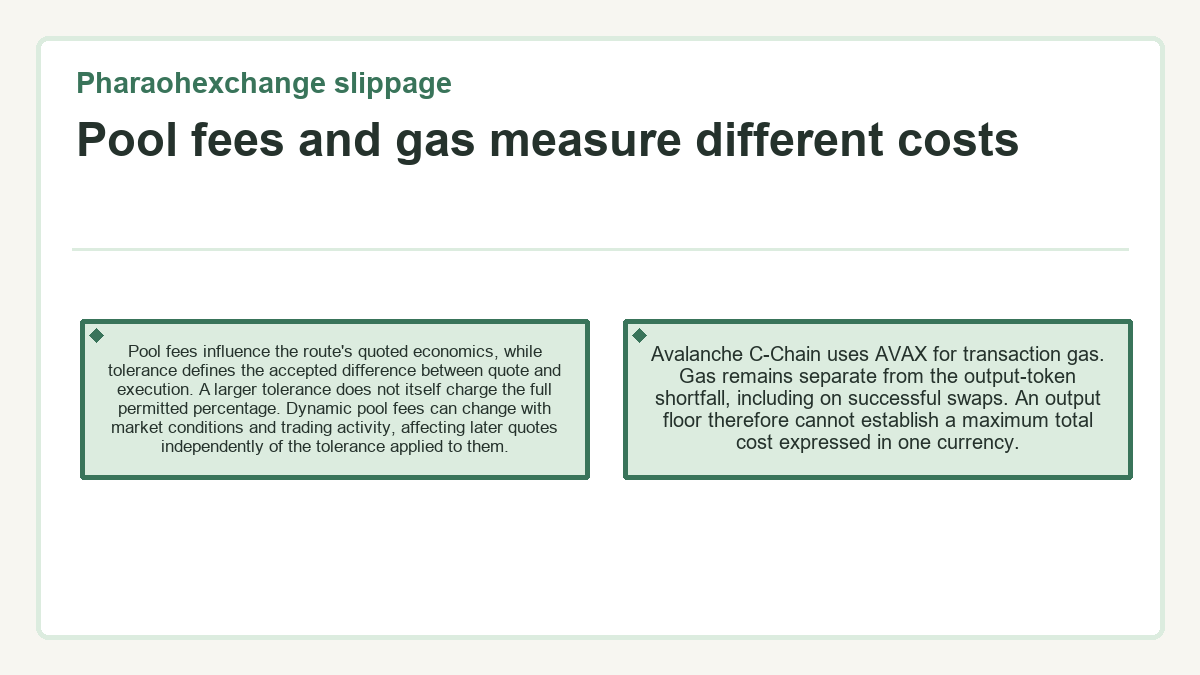
Pool fees influence the route's quoted economics, while tolerance defines the accepted difference between quote and execution. A larger tolerance does not itself charge the full permitted percentage. Dynamic pool fees can change with market conditions and trading activity, affecting later quotes independently of the tolerance applied to them. Avalanche C-Chain uses AVAX for transaction gas. Gas remains separate from the output-token shortfall, including on successful swaps. An output floor therefore cannot establish a maximum total cost expressed in one currency.
What does a rejected swap actually tell you?
An on-chain swap rejection establishes that execution conditions failed; available error details can identify whether minimum output or another requirement caused the failure. Routes can also become unexecutable when liquidity changes. A generic failure message cannot isolate the cause, and a worse current quote cannot establish what happened during the earlier attempt.
An output-below-minimum error identifies the violated boundary; the failed swap did not complete an exchange at that lower amount. Enlarging tolerance would permit different outcomes on another attempt. If the newly allowed output is unacceptable, waiting for another quote or leaving the trade unsubmitted preserves the existing acceptance boundary.
A reverted on-chain swap can still consume gas. Repeated attempts can therefore add costs even when no token exchange completes.
Confirmed output and the next quote
A pending transaction has no final received amount, so a submitted hash alone cannot establish realized slippage. The confirmed transaction record supplies execution status and token movements. A wallet display can lag; a balance change by itself may also combine the swap with other activity. The relevant output belongs to the specific transaction being assessed.
A fresh quote describes the next possible trade. It cannot reconstruct the pool state the rejected attempt encountered.
Useful evidence before another attempt includes the original quoted output, the submitted minimum and the recorded failure reason. The selected tokens and input amount must match when comparing quotes. A changed route or revised input creates a different comparison, even when the tolerance percentage remains unchanged.
For a successful fixed-input swap using the full quoted input, let
A
represent actual output in the quoted token. Its output-token shortfall is
Q - A
; its percentage shortfall relative to the saved positive quote is
100 * (Q - A) / Q
.
Things people ask about Pharaohexchange slippage
Can a swap return more tokens than its quote showed?
A fixed-input swap can return more output tokens than quoted when execution conditions improve. Minimum received sets a lower bound, so that check does not cap output at the quote. The confirmed token movements establish the delivered amount; the tolerance percentage alone cannot predict a favorable change.
Does a token approval preserve the quoted exchange rate?
A token approval does not reserve a quoted rate or pool liquidity. It grants a contract permission to use the specified token, separately from executing the swap. Pool conditions can change while approval confirms. An approval confirmation therefore does not establish the output amount a subsequent swap will deliver.
Is zero slippage enough to ensure execution?
A zero slippage setting cannot ensure a swap executes. Where the setting makes minimum received equal to quoted output, any shortfall in the output amount the router checks fails its minimum-output test. Liquidity and other execution requirements still matter. The submitted output floor gives the concrete boundary; the setting does not freeze the quoted pool state.
What does a swap deadline control?
The legacy router's deadline limits how late its swap call may execute. Its check rejects execution when the block timestamp exceeds the supplied deadline. Execution at the deadline passes this time check, subject to remaining requirements. Increasing slippage tolerance cannot satisfy an expired deadline, and the deadline does not promise confirmation before that time.
Will a wider tolerance fix a swap into the wrong token?
A wider tolerance cannot correct the identity of the selected output token. Minimum received measures an amount of that token, so a swap can satisfy its floor while delivering an unintended asset. Matching the selected token's contract identity matters independently of execution pricing, especially when names or tickers look alike.
Where do intermediate tokens go during a V3 multi-pool swap?
The V3 SwapRouter's exactInput method receives intermediate outputs in the router and uses them in subsequent pools. The final pool sends output to the specified recipient. Intermediate movements therefore do not represent separate completed wallet purchases. This handling describes that router method, rather than every possible liquidity-routing implementation.
How can a stablecoin swap still have slippage?
A stablecoin pair still trades against finite liquidity whose balances can change before execution. A curve designed for correlated assets can reduce price impact near their shared value. Other trades, liquidity changes or movement in the assets' relative prices can still alter output. Similar token prices do not reserve the quoted exchange rate.
When can a refreshed quote lower minimum received despite an unchanged setting?
A refreshed quote can lower minimum received when it offers fewer output tokens for the same input under the same relative tolerance. The percentage applies to the revised quote, so it can preserve the percentage while changing the absolute floor. Comparing output-token amounts reveals this change more directly than comparing tolerance labels.