 Pharaohexchange
 concentrated liquidity: range activity and fee eligibility
Pharaohexchange concentrated liquidity (CL) remains active on Avalanche C-Chain only while the pool price sits within the position's selected range. Outside that interval, the position stops supporting swaps until price returns or the liquidity moves to another range. Active liquidity does not automatically earn direct swap fees: gauged pools default to allocating those fees to xPHAR voters, subject to pool-specific splits. PHAR farming rewards depend on separate gauge conditions. A flat fee balance alone does not identify an inactive position.
When does a CL position stop supporting swaps?
A CL position stops supporting swaps when the pool price moves outside its bounds, even if other positions keep the same pool trading. Moving out of range does not withdraw its assets or erase previously accrued claimable balances. If price returns, the existing position can supply liquidity again without a new deposit, provided its liquidity remains in place. New swap-fee income requires trading and an LP fee share. PHAR emissions depend on eligible active liquidity over time and the gauge's reward allocation.
Fee recipients before range changes
The pool's fee split determines whether an active liquidity provider (LP) receives swap fees at all, so an unchanged fee balance can have an explanation unrelated to range width.
Gauged pools
For a pool with a gauge, the default split directs 100% of swap fees to xPHAR voters. Pool-specific settings can change that split. Eligible LPs may earn PHAR emissions through the gauge, even when direct fee income is zero.
Pools without a gauge
Without a gauge, the documented default allocates 95% of swap fees to liquidity providers and 5% to the protocol. These percentages divide fees collected on swaps; they do not describe returns on deposited capital. Each LP receives only its applicable share.
Fee rate and fee recipient answer separate questions. A higher rate charges more on the same swap amount, while trading volume affects total fees. Where LP fees apply, competing active liquidity also affects an individual position's share.
Narrow bands and wider exposure
Range width changes how much liquidity competes around a given price, how often a position leaves active trading and how quickly its token composition changes.
Capital near the trading price
At equal deposited value, a tighter range concentrates more liquidity near the prices it covers. That can increase the position's share of eligible rewards while it remains in range. Additional depth can also reduce slippage for swaps crossing those prices. A larger share while active says nothing about how long price will stay inside the interval.
Exposure between the boundaries
Wider ranges trade some concentration for more room before a boundary crossing. They still change the provider's token mix as swaps move the pool price. A tight range can amplify the difference between the LP position and simply holding its starting assets. Fees and emissions may offset that difference, but neither automatically covers it.
More frequent repositioning adds transactions and can involve exchanging assets for the next deposit.
Tick boundaries and the matching pool
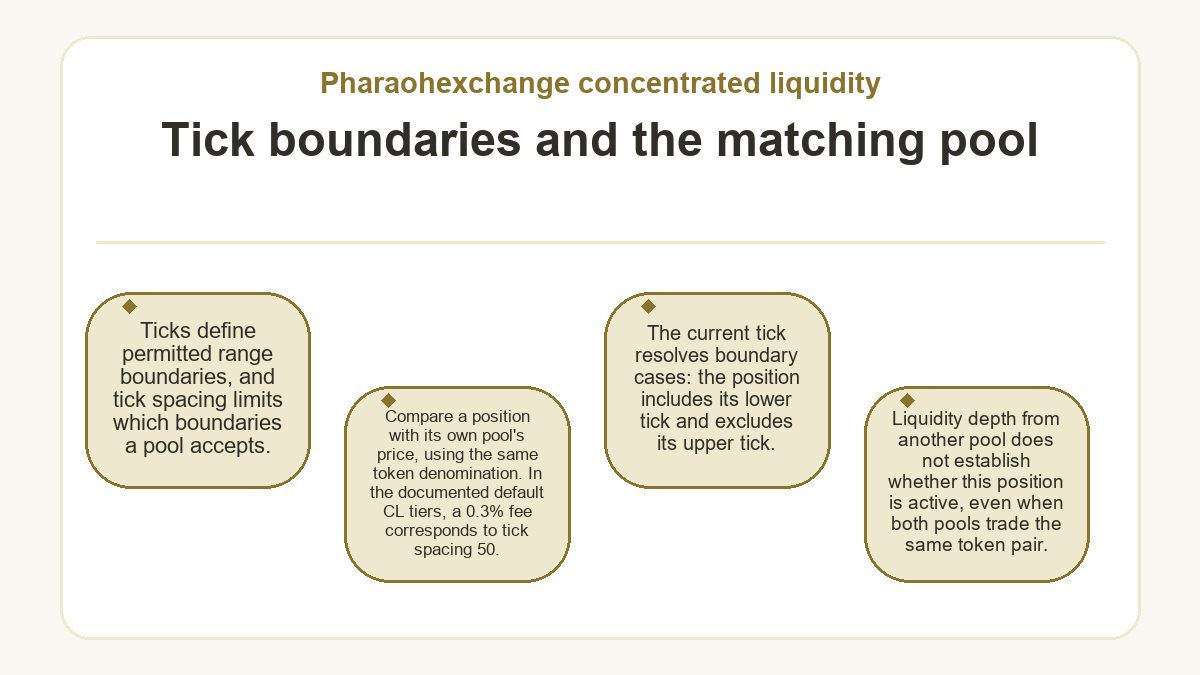
Ticks define permitted range boundaries, and tick spacing limits which boundaries a pool accepts. Compare a position with its own pool's price, using the same token denomination. In the documented default CL tiers, a 0.3% fee corresponds to tick spacing 50. The current tick resolves boundary cases: the position includes its lower tick and excludes its upper tick. Liquidity depth from another pool does not establish whether this position is active, even when both pools trade the same token pair.
Gauge emissions alongside swap fees
A gauge links an eligible liquidity position to PHAR emissions, while the pool's fee split separately governs any swap fees the position can receive.
Depositing assets creates liquidity; earning gauge emissions may also require staking the eligible position in an active gauge. Competitive farming rewards productive concentrated liquidity, so deposited value alone does not determine its allocation. xPHAR voting directs PHAR emissions between gauges, and votes can shift rewards away from a pool between epochs. Keeping a range active addresses the liquidity side of that relationship. It does not create a gauge or complete a required staking step. Direct liquidity incentives also differ from vote incentives, which go to xPHAR voters.
Decide whether to replace an inactive range
A replacement intended to restore activity needs bounds covering the pool's trading price. AVAX on Avalanche C-Chain must be available before submitting on-chain changes. Planning different bounds does not move deposited funds.
- Compare the existing bounds with the same pool's price. Missing fee income alone does not establish an inactive range.
- Review the proposed bounds, required token amounts and any token approvals before signing. The existing position can remain unchanged during this comparison.
- Account for gauge staking before removal. Unstake first if required, then remove the liquidity being moved and deposit the required tokens at the new bounds.
- After the replacement deposit confirms, reconcile its token amounts and bounds with the intended position. Complete any required gauge staking.
- Compare the confirmed range with the pool price again. If price has already left those bounds, the replacement is inactive.
What can a position's APR tell you?
A projected annual percentage rate (APR) estimates earnings under assumptions about activity, liquidity and rewards; it cannot establish the final return on a particular CL position.
Compare earned token amounts over the same measurement period. Include both underlying assets, emissions actually earned and transaction costs when assessing the outcome. A lower position value alone does not quantify impermanent loss, because holding the same assets could also have lost value. Compare the underlying position's value with the value of holding the starting token amounts over that period. Exclude fees, rewards and transaction costs when isolating impermanent loss. A position can earn rewards while underperforming that holding comparison. Changes in PHAR's price also change the value of emission rewards, even when the number of earned tokens stays unchanged.
Range orders and conversion reversals
Concentrated liquidity can express a take-profit sell or a buy-limit allocation through a chosen price band, with conversion occurring as swaps traverse that band.
Conversion during trading
The position changes its token composition as trading moves through the range. Any fee income follows the pool's split, including configurations allocating no direct swap fees to LPs. A partial crossing can leave both assets in the position; the target price appearing on a chart does not establish a completed conversion.
Reversal before withdrawal
A range order can reverse its conversion if price retraces the range before the provider withdraws the destination asset. Leaving liquidity deposited allows later swaps through the range to change its token mix again. These mechanics support take-profit selling and buy-limit positioning. They do not provide the same behavior as a stop-loss or buy-stop order.
Legacy pools and DLMM liquidity shapes
Legacy pools remove the need to select a bounded active interval, while DLMM adds control over liquidity weighting inside a range.
Legacy volatile and stable pools use their full swap curves. This reduces range-management demands, although prices still change asset balances and position value. DLMM, the Dynamic Liquidity Market Maker, divides liquidity into discrete price bins with individually adjustable allocations. A CL position uses one continuous tick interval. Widening that interval changes its coverage without independently weighting liquidity at each price. DLMM offers that additional shaping control. Its Curved preset for stable pairs concentrates depth near the peg while retaining liquidity at the edges.
Before you start with Pharaohexchange concentrated liquidity
Is a single-token CL deposit possible?
A CL position entirely above or below the current pool price can use a single asset. The required token follows the range's direction relative to that price. A position spanning the current price generally needs both assets, with their amounts determined by the chosen bounds and pool price.
Must I hold xPHAR before supplying concentrated liquidity?
Supplying a CL position uses the pool's underlying assets and does not require an xPHAR voting balance. xPHAR has a separate role in directing emissions. Holding it does not automatically stake a liquidity position in a gauge or make that position eligible for every reward.
When do votes change a CL pool's PHAR emissions?
Votes during an epoch determine emission allocation for the following week. Pharaohexchange uses seven-day epochs resetting every Thursday at 00:00 UTC. The resulting allocation goes to the pool's gauge, where eligible liquidity competes for rewards; the pool's vote share does not establish an individual LP's return.
What does the seven-day band in the CL chart represent?
The seven-day band shows the pool's historical price range. It supplies context for recent volatility, alongside the liquidity depth and chosen position bounds. It does not define a future trading corridor or establish how long a new position will remain active.
Can adding tokens reactivate an out-of-range position?
Adding liquidity at unchanged bounds does not move the position's active interval. If the pool price remains outside those bounds, the added liquidity remains out of range too. Reactivation requires price to return or liquidity to occupy a different range containing the trading price.
Will replacing a CL position require new token approvals?
A replacement deposit may require token approvals before the deposit can complete. The required permissions depend on the assets and contracts involved. An approval authorizes token use; it does not itself establish a funded CL position. Review its token and spending amount separately from the deposit transaction.
Can a CL pool's swap fee change after I deposit?
Pharaohexchange supports adjustable CL swap fees, so an initial fee tier does not fix the rate permanently. Fee-setting controls can change the pool's rate as market conditions change. The pool's tick spacing remains a separate parameter, and a fee adjustment does not move an existing position's bounds.